We’ve all heard the prediction “SCORM is dying”. For years, SCORM has been critiqued and labelled as old-fashioned, outdated, unengaging, you name it. However, it’s important to separate the standard from the content. SCORM is a learning standard, a protocol for interoperability. It’s the delivery truck, not the cargo. Blaming SCORM for boring training curriculum is like blaming a shipping crate because you don’t like the shirt inside. When you look past the “SCORM is dead” headlines, you find the standard is still doing exactly what it was designed for: to ensure compatibility across a vast, diverse ecosystem.
SCORM isn’t an obstacle to modern tech. It’s simply the wrapper that helps your content talk to your LMS. With the right approach, and perhaps a little help from our content distribution solutions, SCORM can deliver dynamic, interactive and personalized learning experiences.
Now that’s out of the way, let’s move on to the good stuff and look at what the data actually tells us.
Here’s how we see SCORM usage
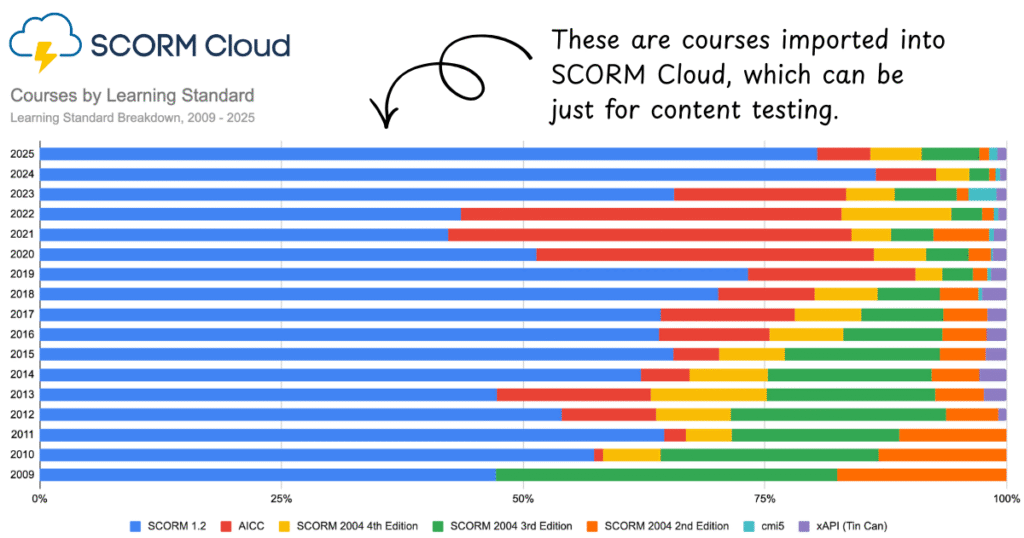
At Rustici Software, we have a unique vantage point. With millions of courses imported and launched every year in SCORM Cloud, we have a front-row seat to how the industry is actually behaving. Now, we’ll be the first to admit there’s an inherent bias here as SCORM is in the product name after all, and SCORM Cloud is widely known as the gold standard for testing content. But because so many people use it as their ‘litmus test’ before going live in an LMS, this data provides a clear view of trends across the global eLearning landscape.
SCORM 1.2 still reigns champion
Despite the rumors of its demise, SCORM usage isn’t just steady, it’s the dominating eLearning standard being imported into SCORM Cloud. In 2025, 92% of registrations, aka actual course launches, are SCORM courses when you combine SCORM 1.2, SCORM 2004 3rd Edition and SCORM 2004 4th Edition together. Surprisingly, some might even call it a SCORM revival.
Why is SCORM still the de facto standard 25 years later? Because the standard is reliable, trusted, widely supported and perhaps most importantly, it provides the consistent, predictable reporting that L&D teams have come to trust for their compliance and completion data. If you break the numbers down further, SCORM 1.2 still claims the majority share. However, we are seeing savvy creators lean into SCORM 2004 for more advanced “choose your own adventure” branching, complex sequencing and larger dataset tracking.
SCORM alternatives
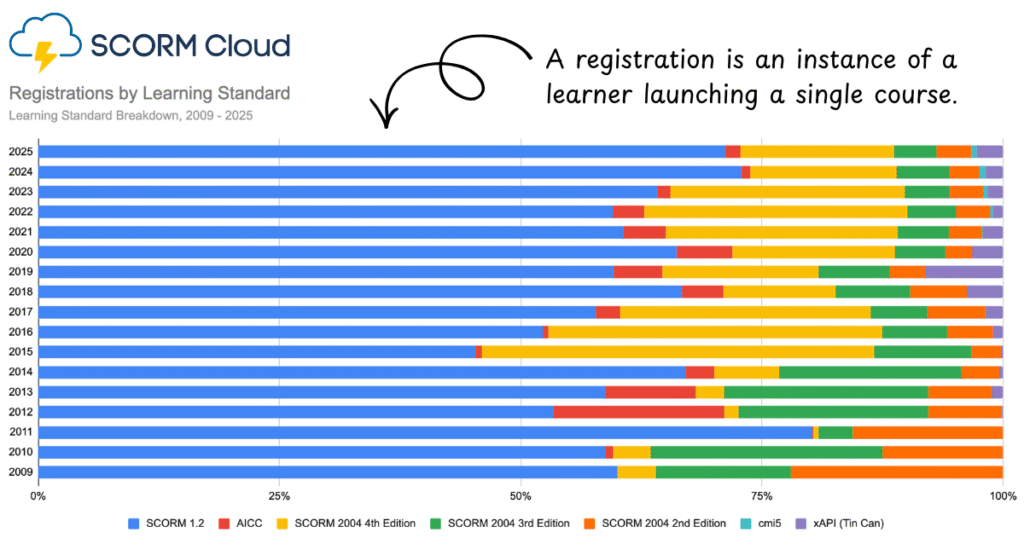
Does SCORM’s dominance mean it’s the only eLearning standard option? Not at all. While the graph shows what is being launched in the real world today, the momentum is shifting behind the scenes. We’ve seen growth in the adoption of cmi5 and xAPI over the last few years. The interesting part? Many organizations are finding ways to enjoy the benefits of advanced tracking with xAPI and cmi5 without the headache of a full ecosystem overhaul. By delivering that tracking inside a SCORM package, you can effectively distribute your content to any LMS, in any standard, without worrying about the technical intricacies of SCORM, xAPI, cmi5, AICC or LTI. It removes the limitations of the standards your LMS supports, allowing you to focus on learning rather than compatibility.
SCORM’s future with AI innovation
If you’re asking yourself, does SCORM still have a place in modern learning ecosystems? Yes! Does using SCORM leave you behind the pack? No. In fact, you can have the best of both worlds! Using SCORM doesn’t mean you have to forgo innovation or settle for static content. With a tool like Rustici Generator, you can now parse your entire SCORM library to find, repurpose or interact with your course catalog at scale without the manual heavy lifting. It acts as a bridge, fueling AI models, powering adaptive search and standardizing metadata so you can unlock the value in your courses instead of digging through them.
You can have your legacy SCORM content and AI-powered platform play nicely together. By mixing the old and new until adoption across the learning industry rises. And it might be worth mentioning that cmi5 and xAPI are a great option to give you more data to track and AI to use while still having the compliance tracking needed in many LMS reports. Want to learn more about AI and standards? Watch our recorded webinar on eLearning standards in the age of AI with Brian Miller and Stephen Kalnoske to hear how important standards are in the current AI landscape and how AI can benefit your training program.